

Namaste in the Land of Gods (part 2)
Posted by: Maria in May 2025 (1 year, 5 months ago)
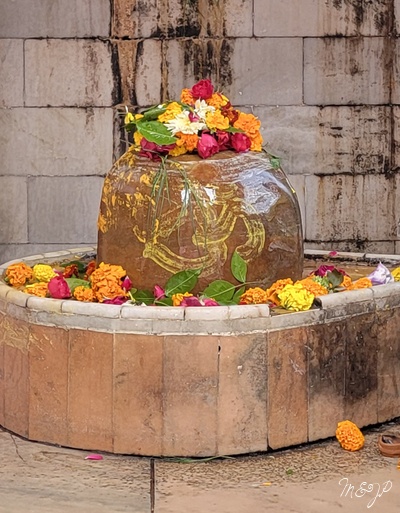
The second healing element of my retreat to the East was going to be the prayers or, if you would like to remove the religious component, the meditation.
PRAY
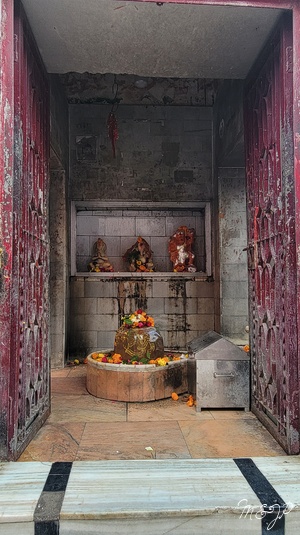
Before setting foot in Uttarakhand, I had some knowledge of Buddhism but didn’t know much about Hinduism, other than what my friend had shared a long time ago on our trips together. Therefore, there was quite a lot I had to take in within only a couple of days - visiting a Hindu temple implies so many rituals and a whole new etiquette to follow! At the same time, I was trying to blend in as most of the time I was the only foreigner there… I wore a long skirt covering my ankles and a long-sleeve top and, before entering the temples, covered my head with a scarf as a sign of respect. Luckily, my brown hair and brown eyes, helped by the scarf, made me look almost like an Indian, as long as I did not open my mouth! A couple of times I was confused for an Indian, including in one of the temples where the priests started talking to me in Hindi!
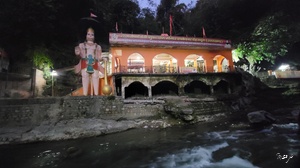
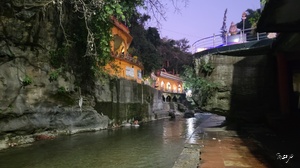
In my “Indian Religions 101” real life class, I learnt that Hinduism and Buddhism have common origins in the culture of ancient India, as well as shared beliefs, practices and even many deities, but also pronounced differences.
Hinduism is the largest religion in India and the third largest religion in the world - behind Christianity and Islam - with more than 1 billion followers. It is also the oldest living religion. Most scholars believe it started somewhere between the 23rd and 15th centuries BCE in the Indus Valley, but many Hindus argue that their faith is timeless and has always existed. Unlike other religions, Hinduism has no one founder but grew out of the interaction between diverse Indian religious groups over centuries of history and is a fusion of various beliefs.
Hindus believe that there is one supreme God that cannot be fully known or understood, and that everything in the universe is part of one substance or nature, but are encouraged to relate to God in the way that suits them best, like worshipping many deities who are believed to be manifestations of God. The three main deities in Hinduism are Brahma - the Creator, Vishnu - the Preserver, and Shiva - the Destroyer. Their feminine counterparts are Saraswati - the wife of Brahma, Lakshmi - the wife of Vishnu, and Parvati - the wife of Shiva.
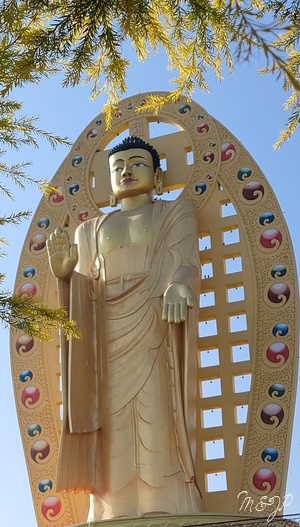
Even though it is only the fifth largest religion in India after Hinduism, Islam, Christianity and Sikhism, Buddhism originated in the Indian subcontinent and is the world's fourth-largest religion, with over 520 million followers. Contrary to Hinduism, it does have a single historical founder as it is based on the teachings attributed to Siddhartha Gautama, most commonly referred to as the Buddha (literally meaning "the awakened one") - a religious teacher who lived in South Asia during the 6th or 5th century BCE and founded Buddhism. According to Buddhist legends, he was born in Nepal to royal parents, but renounced his home life to live as a wandering ascetic. After leading a life of mendicancy and meditation, he attained nirvana at Bodh Gaya in what is now India. The Buddha then wandered through the lower Indo-Gangetic Plain, teaching and building a monastic order. According to Buddhist traditions, he taught a Middle Way between sensual indulgence and severe asceticism, leading to freedom from ignorance, craving, rebirth, and suffering.
Contrary to Hinduism, Buddhism has no creator god to explain the origin of the universe. Instead, it teaches that world-systems come into being, survive for a time, are destroyed and then are remade naturally without the intervention of gods. The great tragedy of existence, from a Buddhist point of view, is that it is endless (individuals are reincarnated over and over again, experiencing suffering throughout many lives) and subject to uncertainty and impermanence (no state, good or bad, lasts forever) and suffering (our mistaken belief that things can last is a chief cause of suffering). Only achieving liberation, or nirvana, can free a being from the cycle of life, death and rebirth.
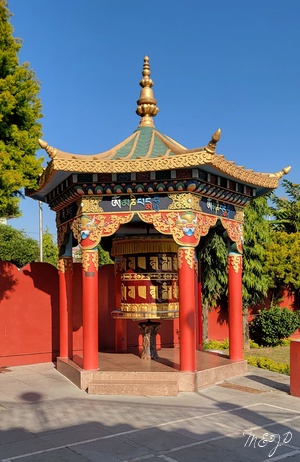
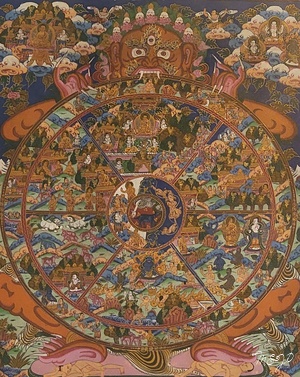
Buddhism has six realms into which a soul can be reborn, something that we had previously discovered during our trip to Bhutan :
- heaven or the home of the gods (a realm of enjoyment inhabited by blissful, long-lived beings);
- the realm of humanity (although humans suffer, this is considered the most fortunate state because humans have the greatest chance of reaching enlightenment);
- the realm of the Titans or angry gods (these are warlike beings who are at the mercy of angry impulses);
- the realm of the hungry ghosts (these unhappy beings are unable to satisfy their craving, symbolised by their depiction with huge bellies and tiny mouths);
- the animal realm (animals are exploited by human beings, and do not have the necessary self-awareness to achieve liberation); and
- the hell realm (people tortured in many creative ways, but not forever - only until their bad karma is worked off).
The first two levels are good places to be born. The inhabitants of the next three levels all have a particular defect (hatred, greed or ignorance), and hell is obviously the worst of the lot. These are not all separate realms, but are interlinked. Thus, although humans and animals live together in the same world, the implications of being born as a human and as an animal are very different, and they are represented as two separate realms. Also, a human being can experience touches of heaven when happy, or the lower states when hateful, greedy, ignorant or in pain. Someone adept at meditation can experience progressively higher heaven realms.
These realms are depicted in a diagram known as the Wheel of Life. The Wheel itself is a circle, symbolising the endless cycle of existence and suffering. In the middle of it are the Three Fires of greed, ignorance and hatred, represented by a rooster, a pig and a snake. These are the causes of all suffering and are shown linked together, biting each other's tails, reinforcing each other. In the next circle out, souls are shown ascending and descending according to their karma. The next ring out is composed of six segments showing the six realms: gods, humans and Titans above and hungry ghosts, animals and those tortured in hell below. The outer ring shows twelve segments illustrating the Buddhist teaching of dependent origination - the chain of causes of suffering. The wheel is held by Yama, the Lord of Death, who symbolises the impermanence of everything. The beings he holds are trapped in eternal suffering by their ignorance of the nature of the universe.
Similarities between Hinduism and Buddhism
Both Hinduism and Buddhism make use of devotional practice or bhakti. Devotion in Buddhism is mainly directed towards the Buddha and bodhisattvas (or Buddhist deities who have attained the highest level of enlightenment, but who delay their entry into Paradise in order to help the earthbound), including chanting or reciting their names or mantras. In Hinduism, bhakti is focused on God (Ishvara or Brahman, the "supreme self"), whether understood as Vishnu, Shiva or Devi - the Sanskrit word for "goddess". Amongst the most revered goddesses are Durga - the goddess of power and protection, Kali - the goddess of destruction, Lakshmi - the goddess of prosperity, Parvati - the goddess of fertility, Saraswati - the goddess of wisdom, music and learning, and Sita - the goddess of beauty and devotion.While the Buddha rejected the existence of a creator God, he did not deny the existence of the gods in general, but argued that they were still mortals, trapped in the same cycle of suffering as other beings and were not necessarily worthy of veneration and worship.
Another common feature of the two religions is that they both agree on concepts such as dharma (behaviours which are in harmony with natural law and virtue), karma and rebirth (or reincarnation), moksha or nirvana (enlightenment or spiritual liberation from samsara or the cycle of reincarnation), yoga, and mantra (or the utterance of a sacred syllable, word or phrase).
Dharma is a term that cannot be translated into English or other European languages. In Hinduism, it is understood to refer to behaviours that are considered to be in accord with Ṛta - the "order and custom" that makes life and the universe possible, and includes religious and moral duties, laws, virtues and, in general, the "right way of living". In Buddhism, dharma refers specifically to the teachings of the Buddha.
Karma is another concept which constitutes a central part of both Hindu and Buddhist teachings. A person's words, thoughts and actions form the basis for good and bad karma - good deeds lead to good karmic results and happier rebirths, and evil actions might result in negative karmic consequences and worse rebirths. One's karmas in previous lives affect one's present existence, and one's actions in this life will lead to effects in this life or the next. Both Buddhism and Hinduism accept that living beings are constantly cycling through different bodies and realms of existence, in a repetitive process or cycle of death and rebirth called saṃsara (literally meaning "the wandering"). Karma is often misunderstood as simply fate, destiny, or predetermination. The concept has also been adopted in Western popular culture, in which the events that happen after a person's actions may be considered natural consequences of those actions.
Moksha or nirvana refers in both Hinduism and Buddhism to liberation, release or freedom from ignorance and saṃsara. In Hindu traditions, moksha is a central concept and the utmost aim of human life, the other three being dharma (virtuous life), artha (material prosperity), and kama (emotional fulfillment).
Yoga - a group of physical, mental, and spiritual disciplines that originated in ancient India - is practiced in both the Hindu and Buddhist traditions. It was first attested in the early first millennium BCE. Nowadays yoga is practiced worldwide. However, "yoga" in the Western world is a posture-based physical fitness, stress-relief and relaxation technique, consisting largely of asanas (or yoga postures), and differs from traditional yoga, which focuses on meditation and release from worldly attachments.
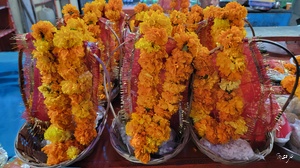
Mantra - an utterance of a syllable, a word or a group of words, believed to have sacred, magical or spiritual powers - is another common concept in both Hinduism and Buddhism. Some mantras consist of the name of a deity or a longing for truth, light, immortality, peace, love, knowledge, and action, while others do not have any actual linguistic meaning but are still considered to be musically uplifting and spiritually meaningful. The word “mantra” is also used in English to refer to something that is deliberately repeated over and over. The most famous mantra is, of course, the sacred sound "OM"!
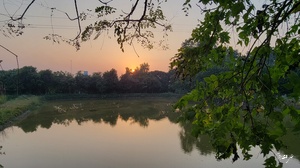
Hinduism and Buddhism also have common symbols such as the mudras (the hand-gestures with which Buddha, bodhisattvas and Hindu deities are often depicted), the Dharma Wheel (a traditional symbol appearing on the national flag of India and on Buddhist temples), the swastika (an auspicious symbol used by Hindus to mark the opening pages of their account books, thresholds, doors, and offerings, and considered by Buddhists to symbolise the auspicious footprints of the Buddha), the lotus flower (a sacred flower symbolizing divinity, enlightenment, purity and higher consciousness), the mandalas (representations of the universe, used in meditation and as a way to connect with the divine), and the tilak, bindi or urna (a dot which Hindu devotees mark their head with, that is interpreted as a third eye and is also one of the physical characteristics of the Buddha).
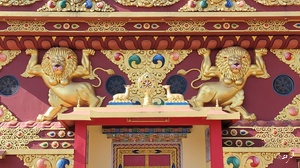
Differences between Hinduism and Buddhism
Despite all their similarities, the two religions are different. For example, Buddhism rejects the priests of Hinduism, and in general the Indian caste system. In India only people from the Brahmins caste can be priests, from the Kshatriyas or Rajanyas caste - rulers, administrators and warriors, from the Vaishyas caste - artisans, merchants, tradesmen and farmers, and from the Shudras caste - labourers, while the tribal people and the untouchables (Dalits) are deemed to be entirely outside the caste system. Also, Buddhists do not recognise the Hindu formal rituals such as ritual bathing in rivers or undertaking other rites for the removal of evil. Hindus believe in the existence of the eternal individual self or soul and that, in order to attain moksha (or nirvana), a human being must acquire self-knowledge through bhakti (devotion) to, and a yogic unity with, God. On the other hand, the only way to seek enlightenment according to Buddhists is through meditation, total non-attachment and acceptance that everything is impermanent, including our self and our soul.
While there is no one central book in either Hinduism or Buddhism, Buddhists only accept the word of the Buddha, while Hindus believe God revealed truths to wise men who passed them on for thousands of years through a rich oral tradition until they were included in several authoritative scriptures. Amongst them are the “Vedas” - a set of four ancient sacred texts written in Sanskrit around the 2nd millennium BCE, which constitute the oldest layer of Sanskrit literature and the oldest scriptures of Hinduism, and the 700-verse “Bhagavad Gita” (or "Song of God") - part of the famous epic tale “Mahabharata” - which is the world’s longest poem, takes the form of a dialog on a battlefield between a prince and Krishna (an avatar of Vishnu), and captures the core beliefs of Hinduism.
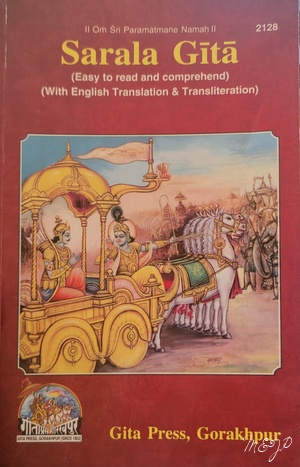
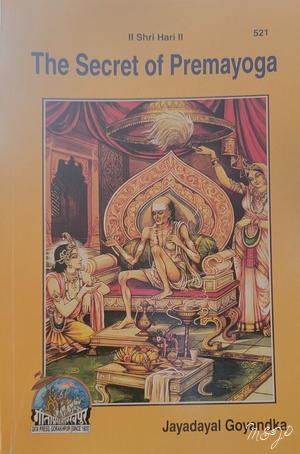
To me, each Eastern "religion" is a way of life and a philosophical tradition, rather than a religion in the way we understand this word in the Western world. A friend once told me that each religion has been created as a way to control people. I think that each concept or idea is in reality what you make of it. You can let yourself be controlled by one religion or seek in it, as well as in any other religion in the world, wisdom and answers to the questions you have. Some rituals might have a calming effect on you, even though you decide to discard their religious component. Also, whatever our belief is, I think that we should always show respect towards other religions and their devotees. For example, while in Japan, we always did the water ablution ritual before entering a Shinto shrine. We washed our hands and mouth with the wooden ladle provided for such purposes not because we were Shintoists, but because we were showing respect to the place and the people worshipping there. This is the approach I adopted when visiting the temples in India - showing respect while looking for peace and quiet and - why not - some answers on my spiritual journey to the East.
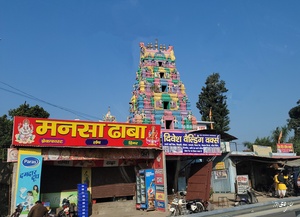
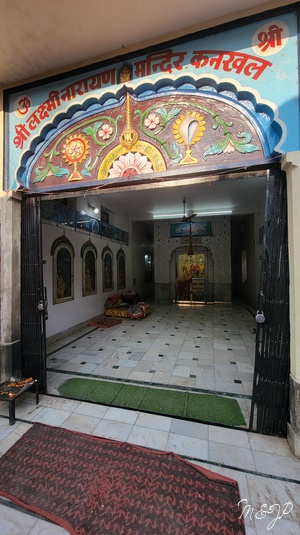
During my week in India, my friend and I visited many temples where I was the only foreigner. Hindus believe that each temple was built in a place where energy had been brought by a very spiritually advanced person such as a guru, a yogi or an ascetic. According to the Indian guru Sadhguru, a temple is not a place to pray or worship but to get energised - you simply need to sit down inside the temple and get the energy in. This is why Hindus do not just enter and exit temples but always stay there at least for a short moment. Also, playing musical instruments, singing, or simply listening to the music in the temples give them energy and lift their spirit. Devotees always walk in a Hindu temple barefoot as this helps them absorb through their foot soles the sacred aura and vibrations of the place and the deity.
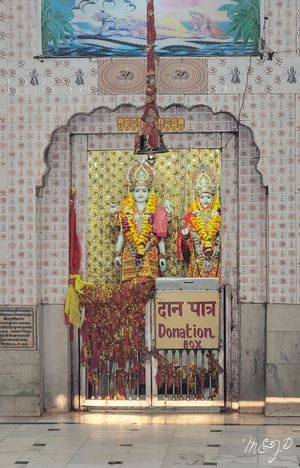
In most temples we simply sat down, closed our eyes and meditated. I must admit that it was hard but I gave it my best, trying to simply concentrate on my breathing and the beating of my heart, ignore the noises around me, and observe my thoughts coming and going without any judgment, questions, anxiety, sadness, anger, regret or guilt.
Dhyana (or meditation - a term derived from the Latin verb meditari, meaning "to think or to contemplate") is defined as a practice used to train attention and awareness in order to achieve a mentally clear and emotionally calm and stable state. Well, it is easier said than done… Meditation is practiced in numerous religious traditions, including Hinduism and Buddhism. It is considered as a way leading to nirvana, the complete end of suffering, through knowledge of the self and unity with God according to Hindus, or insight into impermanence and non-self according to Buddhists. The “Vigyan Bhairav Tantra”, a text which could have been written at some time from the 7th to the 8th century CE, presents in a compressed form around 112 meditation methods or centering techniques! These include several variants of breath awareness, concentration on various centers in the body, mantra practice, visualizations and contemplations which make use of the senses.
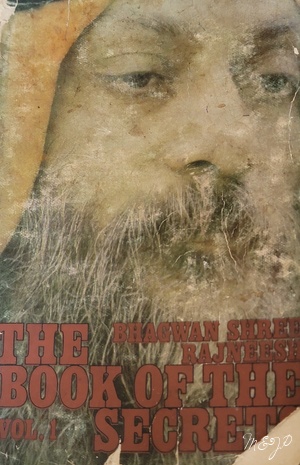
According to the Buddha’s teachings, meditation is like cleaning the house of your mind. Every day your mind collects dirt from anger, worries, stress and endless chatter. Meditation removes that dirt, leaving your mind fresh, calm and alive. Meditation is not about adding something new to your life, but about removing what blocks your inner peace and recovering the treasures of clarity and freedom that are already within you. When your mind is peaceful and free, life becomes a beautiful place to live.
Mediation is also practised for its health benefits, independently from any religious or spiritual influences. It is believed that it may significantly reduce stress, fear, anxiety, depression, and pain, and enhance peace and well-being. Practicing meditation helps you relax your body and mind, feel more balanced and emotionally stable, and improve your concentration. To raise awareness about meditation and its benefits, the General Assembly of the United Nations even proclaimed 21 December as “World Meditation Day”, recalling the right of everyone to the enjoyment of the highest attainable standard of physical and mental health.
In addition to meditating in the temples, I was also trying to take in all the wisdom I could get from chatting with my friend. I particularly liked one of the stories from the epic “Mahabharata” that she told me - the story of surrender. Once you have heard it, you will realise that, contrary to the initial impression, it is not a religious one but basic wisdom and common sense.
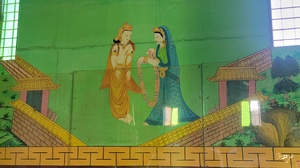
It is a powerful story about the attempted disrobing of Draupadi, which stands as a testament to her devotion and surrender to Lord Krishna during a moment of utter helplessness. The tragic event unfolded when Maharaja Yudhishthira, in a fateful game of dice, lost everything, including his kingdom, his brothers, and even his wife, Draupadi, to the wicked prince Dushasana. The latter then dragged Draupadi into an assembly of elders with the intent to publicly humiliate her by stripping her of her sari. Initially, Draupadi tried to protect herself by holding onto her sari, but she was no match for the physically powerful Dushasana. Desperate, she looked to the elders in the assembly for help, but they remained silent. Realizing that no one would come to her aid, Draupadi finally turned to Lord Krishna and chanted his name in desperation. Hearing Draupadi’s cries, Krishna immediately intervened. He provided her with an endless supply of cloth, rendering Dushasana’s efforts futile. The more Duhshasana tried to pull off Draupadi’s sari, the more cloth appeared, until he was exhausted and had to give up. Draupadi was thus saved from the greatest dishonor through Krishna’s divine intervention. When Draupadi asked Krishna why he didn’t protect her immediately when she first called out for help, he explained, "At first, you relied on your own strength, trying to hold onto your sari. So, I thought, let her strength protect her. Then, you called upon the elders. I thought, let them help. But when you called upon Me alone, I immediately came to your aid. That is why I didn’t come to help you immediately.". The moral of the story is that after Draupadi had surrendered herself to God, a miracle happened. In life we will inevitably face difficult situations, much like Draupadi did, and it is natural to seek help from our own strength and wealth, or from others around us. However, sometimes you just have to surrender to God, the universe or whatever energy you believe or not is out there. Sometimes, you just have to let go and wait to see what will come out. This is probably why I love Mika’s song "Relax, Take It Easy" so much (I agree that the association between a story from the “Mahabharata” and a song is unusual..) - just read through the lyrics!
Took a ride to the end of the lineWhere no one ever goesEnded up on a broken train with nobody I knowBut the pain and the longing's the same when you're dyingNow I'm lost, and I'm screaming for help alone (...)It's as if I'm scaredIt's as if I'm terrified (...)It's as if I'm playing with fire (...)Oh, there is an answer to the darkest timesIt's clear, we don't understand itBut the last thing on my mindIs to leave you, I believe that we're in this togetherDon't scream, there are so many roads leftRelax, take it easyFor there is nothing that we can doRelax, take it easyBlame it on me or blame it on you
Everything is predestined, everything is a divine play… We should not fight the universe and its energies because we are all connected to them, and the most powerful energy in the world is love. Once we surrender, we are in the flow of the universe and we start loving each single human and other living beings because we are all part of the whole, part of the universe. We are able to forgive those who harmed us because they are us. Sometimes it might seem difficult, and even impossible but you need to forgive them - not for them but for yourself, because you respect yourself. When people hate you, that hate burns your bad karma! Thinking this way will also help you respond, instead of react, and therefore spare any negative energy. My mom used to tell me to always count to 10, or take 10 breaths, before answering… This might seem pretty hard but remember that every human being who hurts you is also hurting… Your answer should be kindness because they do not know better! Remember the Dalai Lama’s words - "This is my simple religion. There is no need for temples; no need for complicated philosophy. Our own brain, our own heart is our temple; the philosophy is kindness."
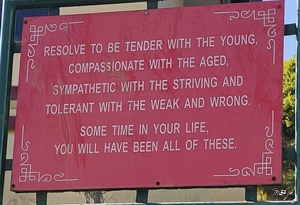
Namaste - the customary Hindu manner of greeting a person with a slight bow and hands pressed together, palms touching, fingers pointing upwards and thumbs close to the chest, used at any time of the day - is also a sign that we are all part of the universe. Namaḥ means "bow" and te means "to you", and therefore namaste literally means "bowing to you". In Hinduism, it reflects the belief that "the divine and self (atman) is the same in you and me", and connotes "I bow to the divine in you" or "the sacred in me recognizes the sacred in you". It is also proof that besides being a religion or a philosophy with lots of wisdom, Hinduism is also very scientific - every act, every ceremony, every gesture has an explanation. Scientifically speaking, joining the tips of all the fingers for the namaste greeting is said to activate the pressure points of eyes, ears, and mind which helps us remember that person for a long time. Also, there are no germs since we do not make any physical contact!
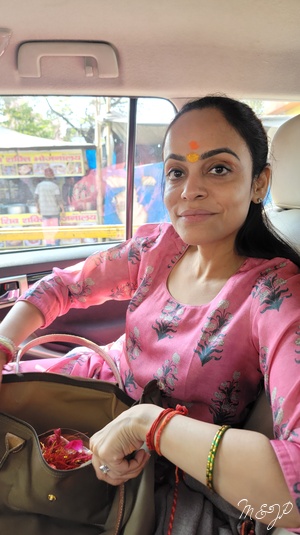
Another Hindu tradition that has a scientific reason is the bindi - the red dot from kumkuma (a powder mainly made from turmeric) - applied on the forehead directly between the eyebrows. Since ancient times, the spot has been considered as a major nerve point in the human body which controls the various levels of concentration and facilitates the blood supply to the face muscles. Indians believe that the human body is divided into seven vortices of energy, called chakras, beginning at the base of the spine and ending at the top of the head, and the sixth chakra, also known as “the third eye”, is centered in the forehead directly between the eyebrows. The energy that is generated from the base of the spine during meditation can rise towards the head and be lost through the third eye chakra - the bindi is supposed to block the loss of this energy and help preserve it in the body. In addition, according to Hinduism, our two physical eyes are used to observe the external world, while the spiritual third eye focuses on the "inside" or one's self. Since Hinduism believes that God resides within one's self, the bindi is also a reminder to keep God at the epicenter of one’s thoughts.
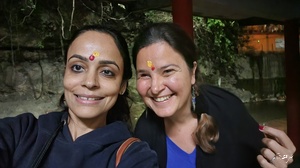
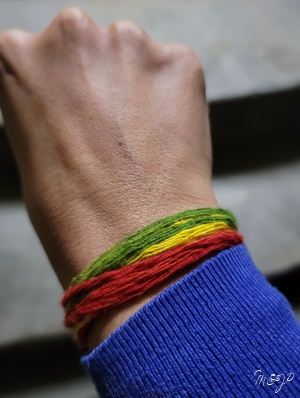
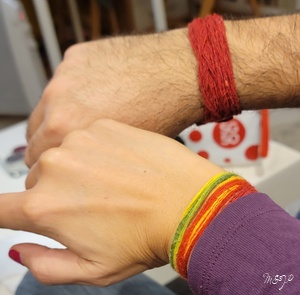
Whenever you go to a Hindu temple or attend a Hindu ritual, your forehead will always be adorned with a bindi, and colourful threads blessed by the Gods (typically called a "rakhi" or a "kalawa") will be wrapped and tied around your wrist for good luck, to ward off evil, or as a blessing. When Lord Krishna cut his finger, Draupadi tore a piece of her sari and tied it around his hand to stop the bleeding. Touched by her concern, Lord Krishna promised to protect her and came to her aid during a moment of distress - this is the story of surrender. By tying the rakhi or kalawa on the right wrist, it is believed that the wearer gains protection and strength to face challenges in life. While rooted in tradition and spirituality, there is a scientific aspect to wearing a thread on the wrist. The wrist is a prominent pulse point - according to human anatomy, it is covered with a web of veins and almost 72,000 nerves of prime veins connect to other body parts from the wrist. When a small amount of pressure is applied on certain points of the body, it can influence the body's energy flow. The thread on the wrist is thought to stimulate this pulse point, promoting well-being and a sense of balance. The custom of Indian women wearing beautiful bangles has a scientific reason as well - the constant friction of the bangles with the wrist where the pulse beats increases the blood circulation level. Also, applying henna on the hands before weddings brings colours but also cools the body and keeps the stress from the approaching wedding day down.
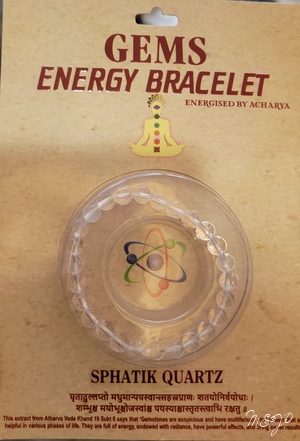
Another example that Hinduism is a science is the belief that we should not sleep with our head towards the North, because this invites death. Based on science, the human body has its own magnetic field interacting with the Earth which is a giant magnet, and this position makes our body completely asymmetrical to the Earth’s magnetic field, causing problems related to blood pressure as our heart needs to work harder to overcome the asymmetry. Also, our body has a significant amount of iron in our blood. When we sleep in this position, iron from the whole body starts to congregate in the brain and this might cause headache, Alzheimer’s Disease or Parkinson disease.
Sitting cross legged while eating is another tradition which can be explained scientifically - this pose normally used for yoga instantly brings a sense of calm and helps digestion. Also, eating with your hands instead of using cutlery is more than a cultural tradition as it also has health benefits. Our hands are equipped with tactile senses that can gauge the temperature, texture, and consistency of the food, ensuring a safe and enjoyable dining experience, discouraging mindless eating and overconsumption and leading to healthier eating habits. Additionally, the act of touching food triggers the release of digestive enzymes in the saliva, facilitating better digestion. It is believed that this intimate engagement with food promotes a harmonious balance between the mind, body, and soul. The absence of cutlery eliminates barriers and formalities, allowing for a more relaxed and convivial atmosphere. Finally, according to Ayurveda, each finger is associated with one of the five elements (earth, water, fire, air, and space), and by using all five fingers while eating, it is believed that one can balance these elements and optimize digestion. The underlying principle behind the Hindu tradition of fasting is also to be found in Ayurveda, according to which the basic cause of many diseases is the accumulation of toxic materials in the digestive system. Regular cleansing of toxic materials keeps one healthy, and by fasting, the digestive organs get rest and all body mechanisms are cleansed and corrected.
Everything seems to have a scientific reason in Hinduism! While ringing the bells in the temples is supposed to keep evil forces away, the scientific reason behind it is that the sound clears our mind and helps us concentrate. It is falsely believed that Hindus are idol worshippers -the reality is that they worship a reminder of God as they believe that a physical representation of God, in the form of an idol, helps them focus on an aspect of prayer or meditation. The tradition of praying early in the morning has a rationale as well - by waking up to follow this routine, we become prone to a morning lifestyle, and mornings are proven to be the most effective part of the day.
The examples of Hindu traditions that can be explained by science are endless... I was going to learn about many of them "live" during our visits to some of the Hindu temples and ashrams in Uttarakhand...
Disclaimer: This article represents the understanding of the author during a trip to India. It does not contain any dietary, health or other recommendations. While most of the information provided is based on verified sources, the author shall not be responsible for any interpretation made from the content of the present article.

You like what you read?
Explore and learn more about India !!!
-
 P for Paradise and Provence (part 2)
Stunning nature - You cannot leave Marseille without hiking to … -
 P for Paradise and Provence (part 1)
France used to be divided into historical regions, which do … -
 The Valley of Roses and Kings (part 2) The Valley of Kings
The Valley of Roses is famous not only for its … -
 The Valley of Roses and Kings (part 1) The Valley of Roses
Out of all the flowers in the world the rose … -
 In the heart of the Silk Road (part 4) Khiva and the Desert Castles
Khiva - It took us 6 hours, almost a whole … -
 In the heart of the Silk Road (part 3) Bukhara
Bukhara - While Tashkent is a modern city with some … -
 In the heart of the Silk Road (part 2) Samarkand
Samarkand - No name is so evocative of the Silk … -
 In the heart of the Silk Road (part 1) Tashkent
The Great Wall of China, Machu Picchu, the Pyramids of … -
 The Land of Giants at the End of the World (part 2)
We crossed for the third time the border between Argentina … -
 The Land of Giants at the End of the World (part 1)
No visitors come back from Antarctica in the same state … -
 A Vitamin Sea Christmas in the Mediterranean
Human beings are full of contradictions! When we used to … -
 Spring Colours in the Kingdom of the West (part 6) Morocco is yellow
Morocco is yellow - Besides the yellow hues of the … -
 Spring Colours in the Kingdom of the West (part 5) Morocco is red
Morocco is red - Besides the red hues of the … -
 Spring Colours in the Kingdom of the West (part 4) Morocco is orange
Morocco is orange - Our first encounter with the legendary … -
 Spring Colours in the Kingdom of the West (part 3) Morocco is green
Morocco is green - The Rif Mountains east of Tangier, …
